
St. Margaret's Bay,
Nova Scotia
St. Margaret's Bay,
Nova Scotia


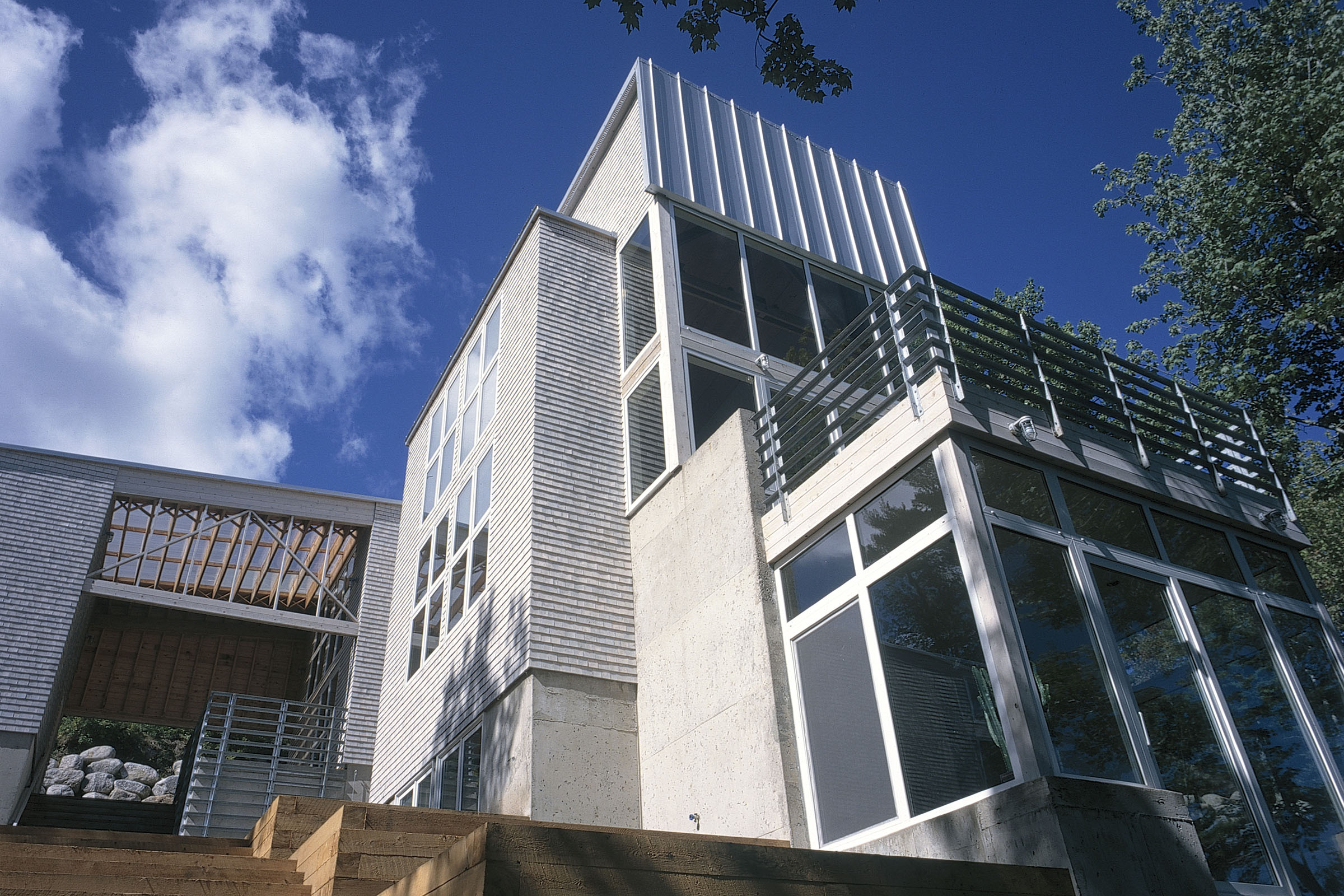
The House consists of two principal elements (house and barn) forming a south-east orientated microclimate courtyard garden, thereby resolving the typical conflict between sun and view orientation along the south-west axis of Nova Scotia’s coast. The barn acts as a mute retaining wall parallel to the road and the slope, while the living spaces are contained in a ship-like, cross-slope pavilion.
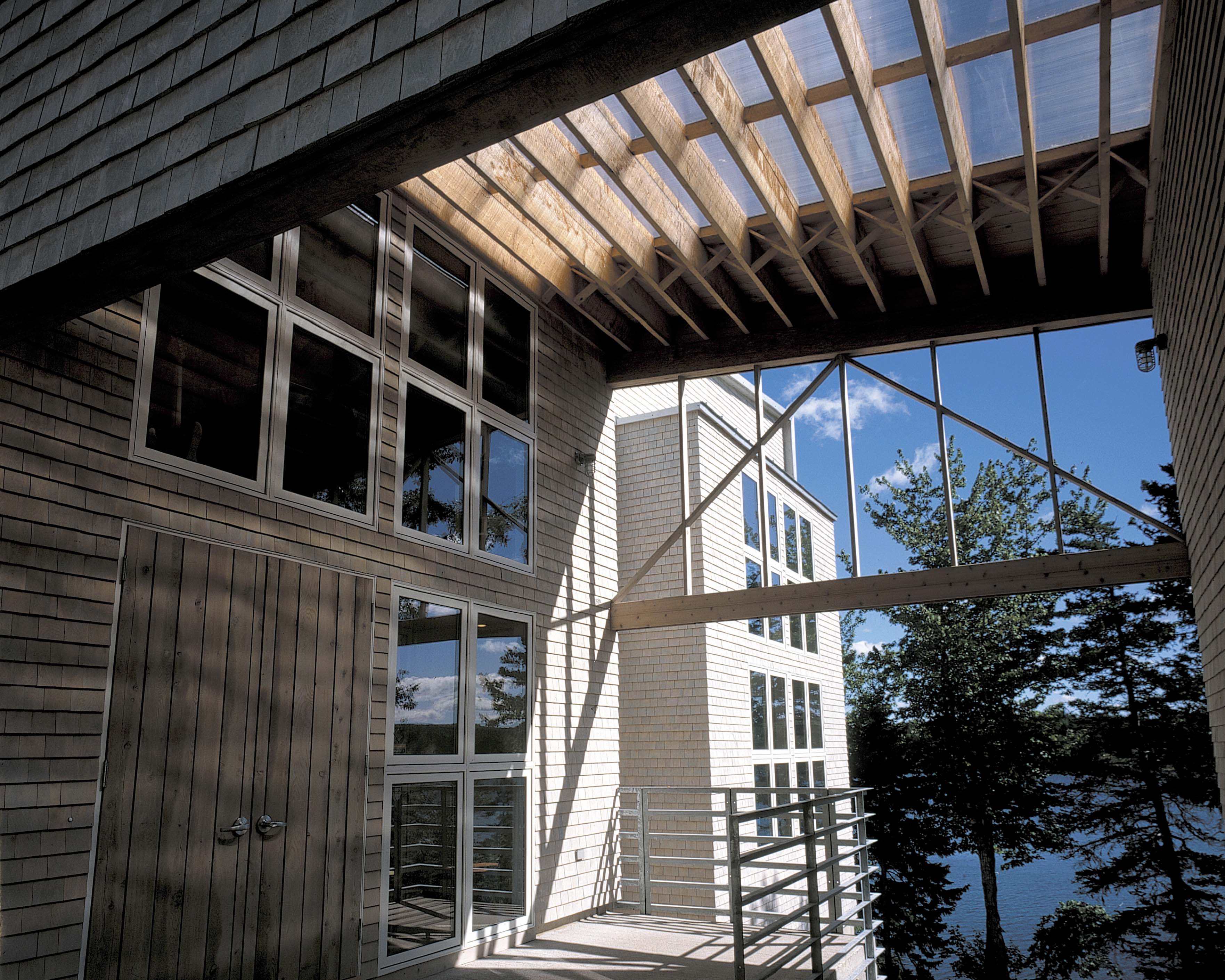
The standing seam galvalume roof folds down on the street facade as a protective gesture, while the house seems to reach out over the water on the sea side. A strong visual axis passes through the entry porch to the existing wharf. One arrives at the porch with its exposed construction, celebrating entry to the site and the building.
This year round home achieves a pavilion-like quality through its sectional strategy, by creating a wide open public level and tucking secondary private spaces under, and best bedroom suite and study in a mezzanine over. This Great Room is a 16' wide hollow tube projecting out to sea. It is the served room which is flanked and articulated by four servant bays, one of which is extruded to become the garage.
As one moves through the Great Room toward the sea, one passes alternately through spaces protected by flanking bays then an open glazed void between the bays. The passage through the house is punctuated by a series of totemic elements. Upon entering, one is aligned with a kitchen island as a foreground element to the working ‘kitchen-in-a-box’, which then reorients one to the long axis of the Great Room. After passing through the dining void, one enters the double height sunken living area which is punctuated by the hearth.
The strategy-for-building begins with a concrete base which transforms the 60' slope across the site into a series of terraces to receive the stick-framed pavilion. The top of concrete line through the Great Room acts as a horizontal datum at 2' above the floor between the sloped ground line below and the opposing slope of the roofline above. This concrete base together with four timber frames form the primary structure for the house. The structure is largely a response to lateral wind loads given the exaggerated height and narrow width of the building. The four wind shear frames form rigid rings which wrap around the Great Room.
A gazebo completes the courtyard while restating the tectonic language of the project.
Awards
1997 Governor General’s Medal for Architecture
1997 Nova Scotia Lieutenant Governor’s Citation
Design Team
Brian MacKay-Lyons
Niall Savage
Doug Wigle
Tony Gillis
Talbot Sweetapple
Hilary Backman
Bruno Weber
Photography
James Steeves
Structural Engineering
Campbell Comeau Engineering Limited
Builder
Cyril Smith


